RUN: ORIENTATION PROCEDURE, PART 3
You’re REALLY pushing my buttons!

Starring BILMAA:
Now then—let’s talk about the real star of this entire mess: The Bureau for the Investigation of Lepidopterological, Meteorological, and Anthropological Anomalies, BILMAA. (Yes, they named it that on purpose. No, I don’t know why. I assume it was the result of a “truth or dare” gone wrong.) Everyone just calls it “The Bureau,” because obviously.
They operated from somewhere in the 3000s through the early 4200s, depending on how you count bureaucratic inertia as “functioning.” My interest lies in their mid-period, the golden age of doing science with a broken stapler, three paperclips, and the kind of budget you’d find in the couch cushions of a collapsing empire, specifically the 3500s.
The Machine...
At the heart of their Narrative Archival Division is a machine so janky, so unfathomably stubborn, it’s a miracle it hasn’t become sentient and staged a coup. Everyone just calls it “The Machine”. *cue Toccata and Fugue in D minor*
It is, to be clear, a relic. It hasn’t been officially updated since the year 3432. That’s not a typo. Maintenance consists of gentle percussion therapy and whispered apologies (that means you smack it then say ‘sorry, I didn’t mean it’ when it makes a noise). Replacing it is financially impossible. Rewriting it is a fantasy. And yet, somehow, it still boots up. Held together by haunted legacy scripts and the exhausted dreams of one truly overworked IT department. I’m also the patron deity of engineers running their gear EOL…so, you can say I have a soft spot for these guys and their machine, bless ‘em.
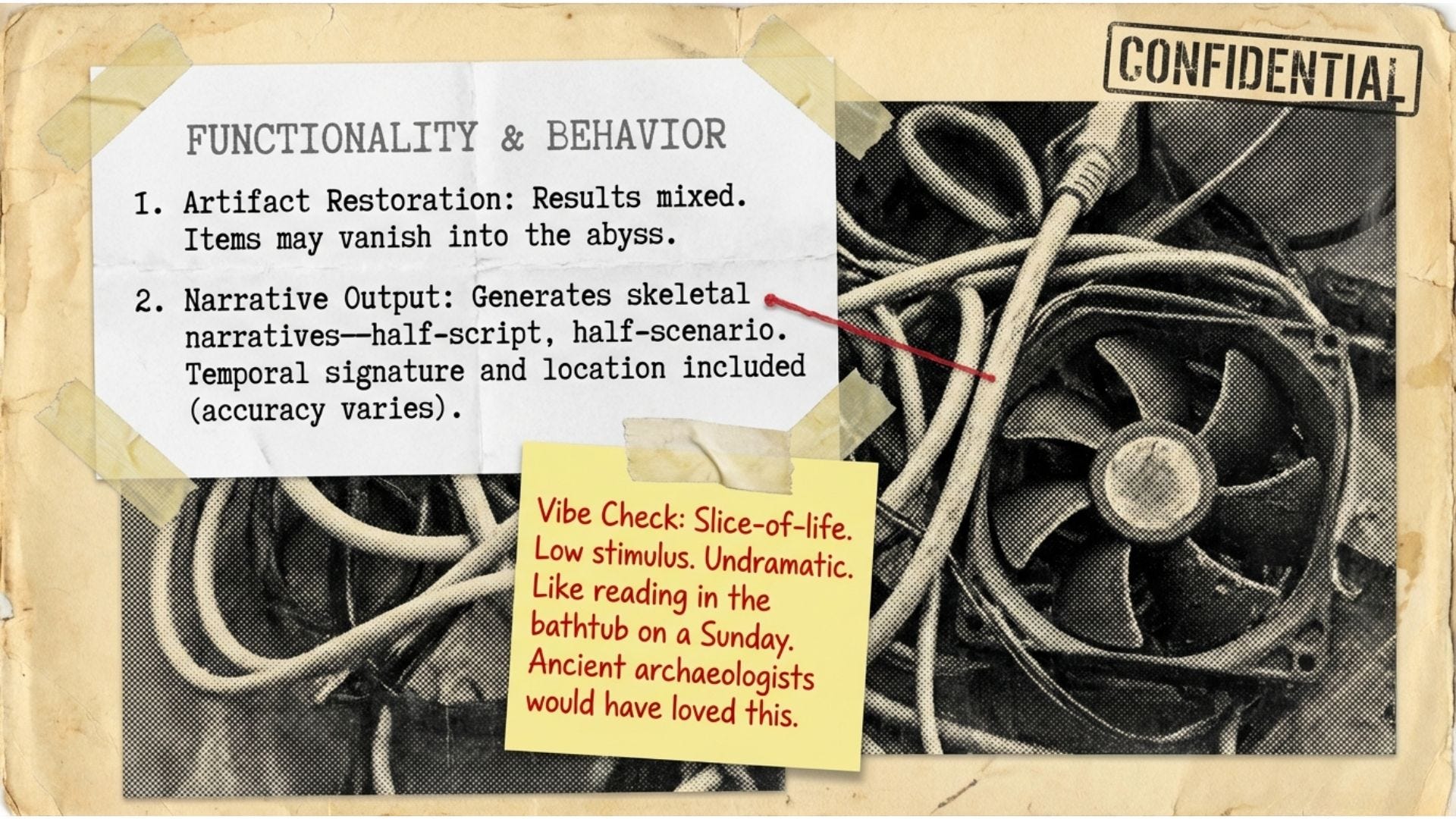
Visually, it resembles a gas-station pizza oven conveyor belt and the back half of a copy machine. Spiritually, it radiates the aura of an ancient cursed printer that still thinks it’s networked. It does two things (when it feels like it). First, it tries to restore physical artifacts, with mixed results. Sometimes they return. Sometimes they vanish into the abyss. Second, it outputs a kind of skeletal narrative, a half-script, half-scenario, all vibes kinda document. It’s usually got a temporal signature and location; also an accuracy rating that I take with a grain of salt. These narratives are... well, they are what they are. You’ll see. Occasionally it puts out a scene without being prompted by an artifact, no one knows why. I’m guessing psychic residue in the filters or NOS error with the “ink”. Overall, they aren’t half bad! I know ancient archaeologists would have loved this! It’s like being a fly on the wall while people are just living their lives; which results in some great slice-of-life, low stimulus, undramatic, reading-in-the-bathtub-on-Sunday vibes.
SO THIS MACHINE...IT HAD SOME BUTTONS.
So about this ghostly and resilient machine…it has…settings…well…buttons. And it’s so old that by the mid 3500s no one really knows how to factory-reset the thing. So this next part of the transmission is all about...buttons, and what I THINK they do.
The mood killer button:
There’s the SFW Protocol. I think it’s the button that has a bed with an X on it. No, not that kind of X. It doesn’t broadcast skin-a-max. It’s apparently designed to prevent the machine from veering into... let’s call it interpersonal intimacy. The moment things get remotely erotic, the machine now overheats trying to comply with SFW Protocol. No joke. A machine that overheats when things get steamy? I mean, The situational irony! By 3500’s, the protocol was less of a safety feature and more of a mood killer with an authority complex. Sometimes sexy tidbits slip by, sometimes a look across a crowded room forces a hard reboot. SMH
LATE NIGHT SNACK BUTTON? NOPE!
There was a small chef hat shaped button-- are you thinking of snacks? ‘Cause I’m thinking midnight munchies! I mean the archivist department had 3 shifts a day, the overnight shift was notorious for foraging in the break room fridge. So legend has it, 3rd shift, late one night–you guessed it, they hit the button. It’s jammed now. So if a narrative mentions food, it tries to reconstruct a recipe and recipe cards end up in the media blitz (we’ll get there, it’s coming). It resulted in an official bureau “culinary reconstruction club”, (because apparently, morale is a line item and everyone’s a foodie)
THE “WHERE ARE WE?” SETTING:
The machine also features a Spatial Report Generator, allegedly designed to produce scalable blueprints of dig sites. It does not, never did. It was one of those features the sales guy played up, but the machine never delivered. What it created in the beginning were surrealist nightmares disguised as diagrams—whimsical renderings of structures that may or may not exist. TBH, some are better than others. It doesn’t do it as much by 3500, so Archivists consider themselves lucky if it spits one out.
THE TV Button (spoiler, it wasn’t a TV.)
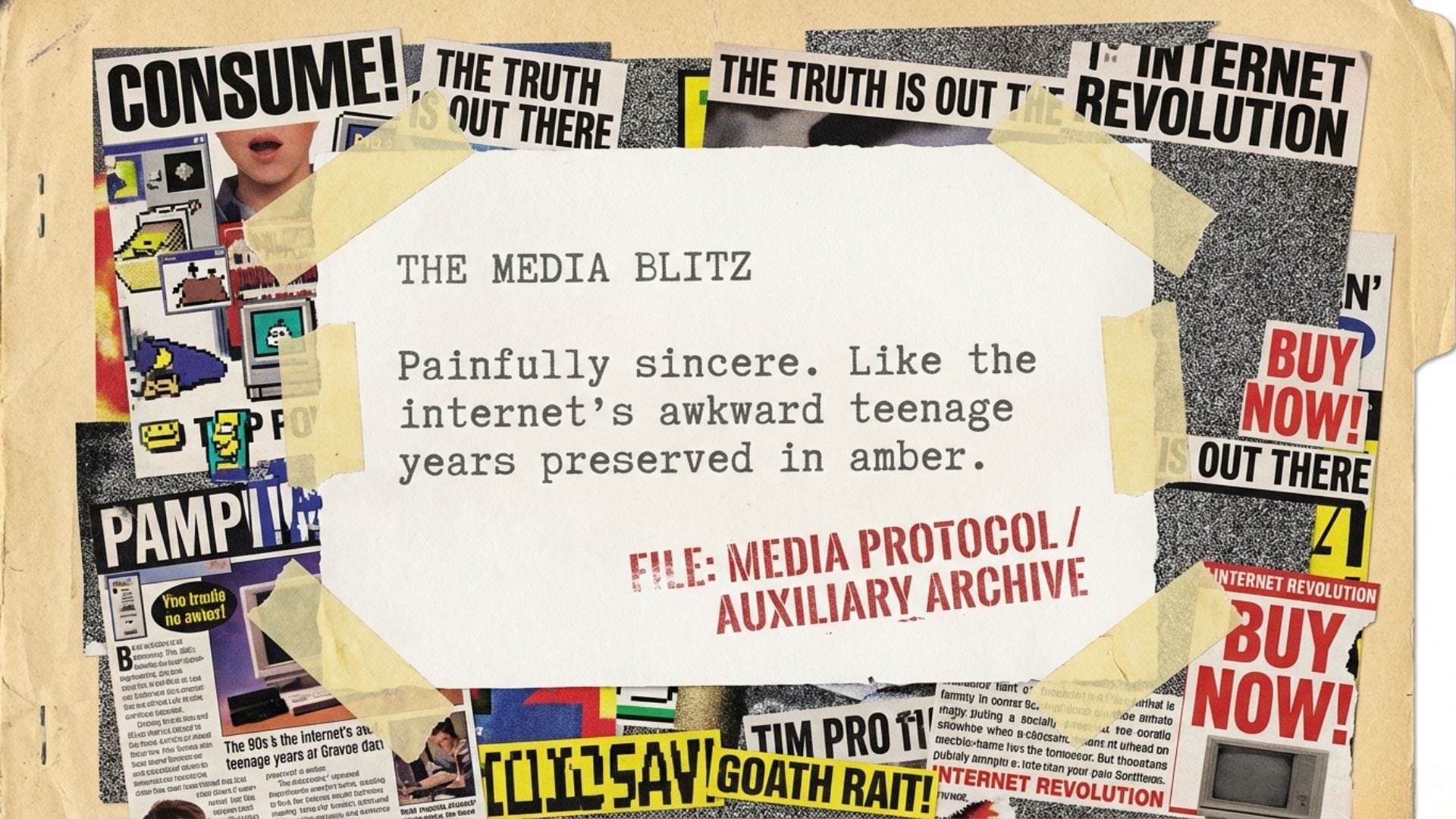
Apparently it was a computer monitor on a stand, like they used to have back in the early 21st century. Shockingly, it does not produce ‘explainer videos’ either, as one would expect. Instead, it activates a media subroutine that floods the system with visual artifacts—text overlays, faux-promo posters, odd aesthetic mashups, and what you would probably call, memes. Also magazine style ads. And let’s not forget the infographics. The occasional recipe card too. They are slightly precious, and painfully sincere--like the internet’s awkward teenage years preserved in amber. Archivists file the first page of the “Media Protocol” in the dossier, the rest is added to an addendum file in the Auxiliary Media Archive. I mentioned it before, “AUX”, I’m actively recreating it on Pinterest. You remember, good job *punches you jokingly on the shoulder*
Also… Not confirmed, but widely assumed: that the (not a TV) button might be why the machine started outputting narratives in the hybrid format. Not quite a tv script, not quite a short story. Just... scriptish…umm…script-adjacent. An uncanny valley of media-type-formatting. You’ll know it when you see it.
*best announcer voice* Ok kids, after these commercial messages, we’ll be right back…with butterflies.